| Home | Book | Overview | Dawkins | byproducts |
Darwin's Apple: The Evolutionary Biology of Religion
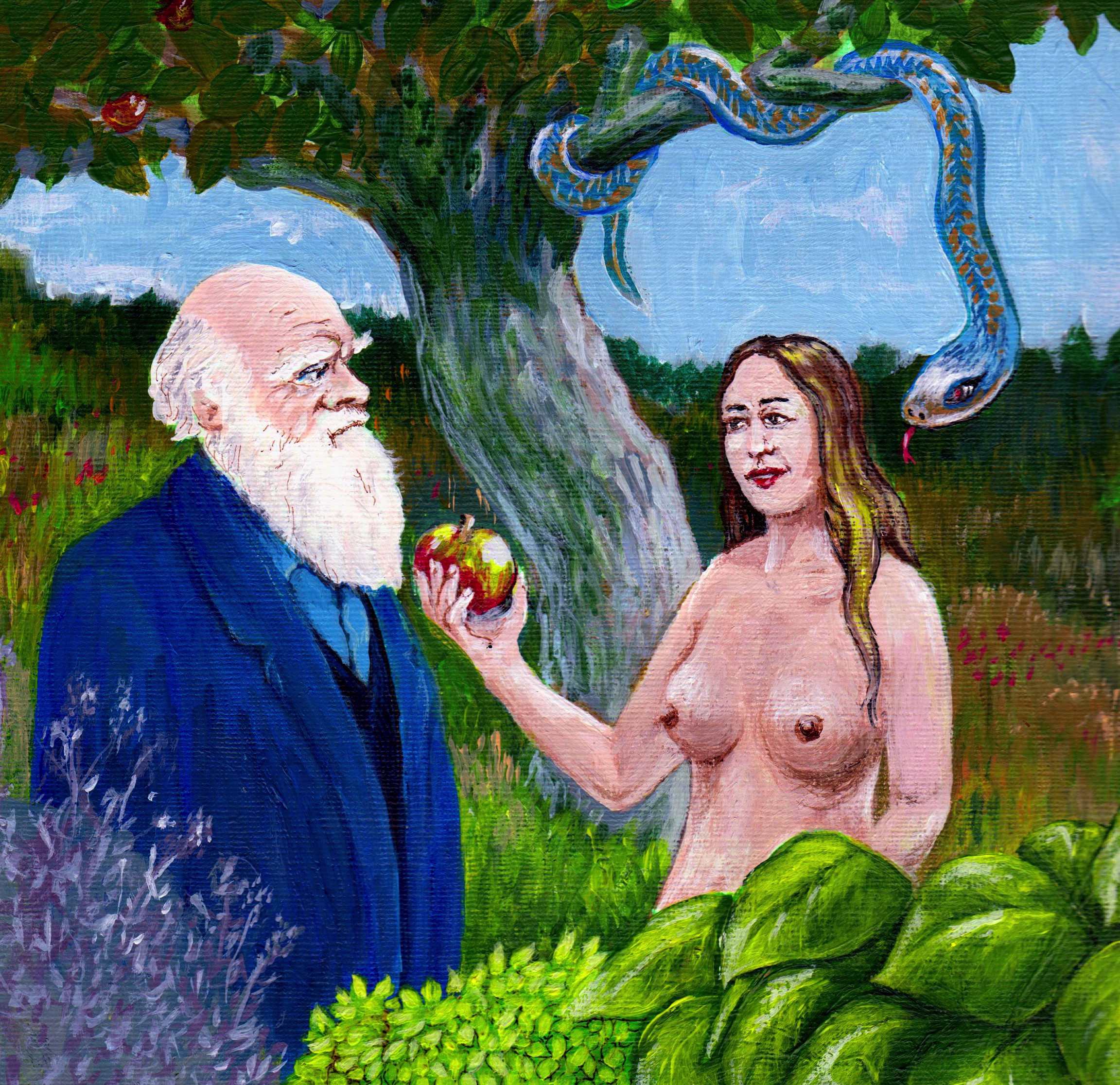
This is the title of my book in-progress (currently undergoing its first revision) that provides a theory of religion steeped in evolutionary science. My theory unifies a wide range of human behavior and shows how rituals such as music, dance, art, mythology, and prayer that traditionally began as religious expressions are adaptive and contribute to evolutionary success.
The most common reasons given for origins or evolution of religion:
- Group cooperation
- Allay fear of death
- Explain the unknown/existential mysteries
- Agency Detection Device
- Byproduct of habit of mind
None of these are all-encompassing and none adequately account for how religion is adaptive and improves evolutionary fitness.
The various theories explaining the evolutionary and biological origin of religion do not show comprehensively how religion is adaptive and increases individual fitness. The Split theory proposes the co-evolution of religion and consciousness—that intrinsic religion is a compensating mechanism for higher-order consciousness. It unifies all ritual and religious behaviors under one umbrella and explains how all these behaviors are adaptive and increase evolutionary success. Empirical science is the basis for this inquiry.
Contemporary scientists such as Daniel Wegner, Antonio Damasio, V.S. Ramachandran, Joseph LeDoux, and John Bargh attest that consciousness, the rational mind, is not solely, or even mostly, the seat of volition as many assume. Humans remain tethered to their biological heritage, which behaviorally is the emotional system. Consciousness gives humans distinct advantages (culture), but it also evolved to be far noisier and distracting than is helpful and necessary. Some of the functions attributed to consciousness are:
- to access a vast trove of memories and consider multiple options simultaneously
- to address novelty and provide choice in "spontaneous" situations
- to enable veto capability after an action, thought, or event
All religious behaviors including music, art, dance, mythology, and prayer evolved to elicit emotions and suppress consciousness to various degrees. Contemporary brain and behavioral research show these ritual activities stimulate the brain's reward systems, and people benefit from them. This would not have happened had they not been evolutionarily adaptive. These ritual behaviors are utilized by psychologists and psychotherapists to help people integrate emotions, which strongly supports their adaptive functions.
Read the chapter-length overview that lays out The Split theory of religion in more detail.